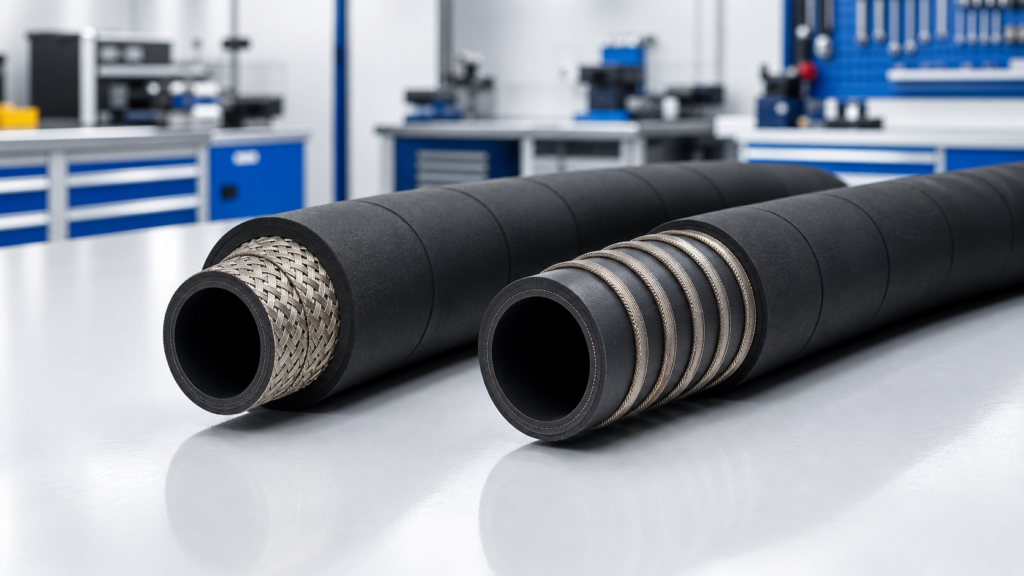
Choosing the right hydraulic hose is not only about pressure rating. A hose that works well on a compact loader may fail too early on a mining excavator, even if both systems use similar hydraulic oil. The key difference often comes from the reinforcement structure: steel wire braided hose or steel wire spiral hose.
This guide explains how to compare braided and spiral hydraulic hoses by working pressure, flexibility, impulse performance, bend radius, installation space, and typical applications.
What Is a Steel Wire Braided Hydraulic Hose?
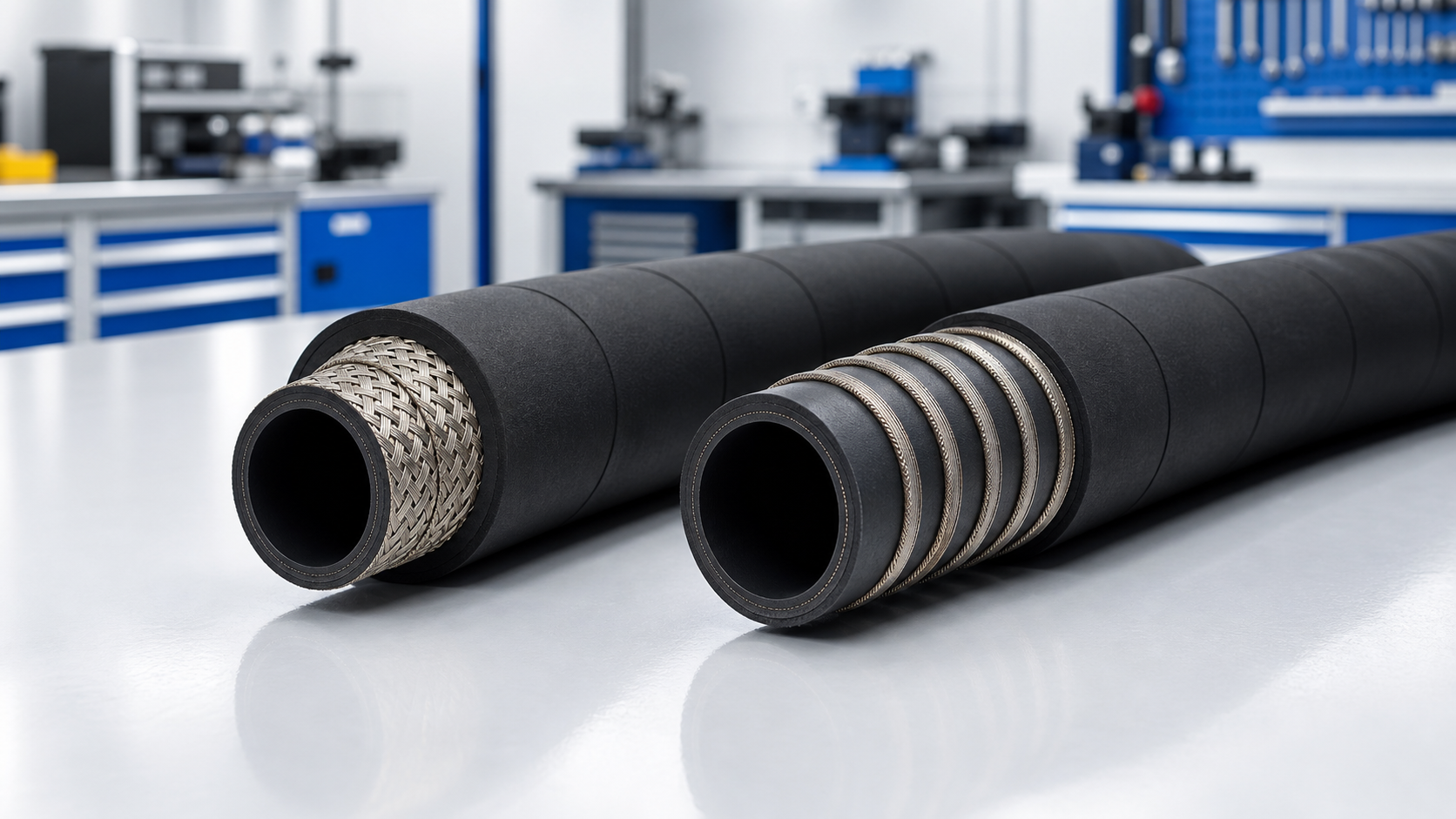
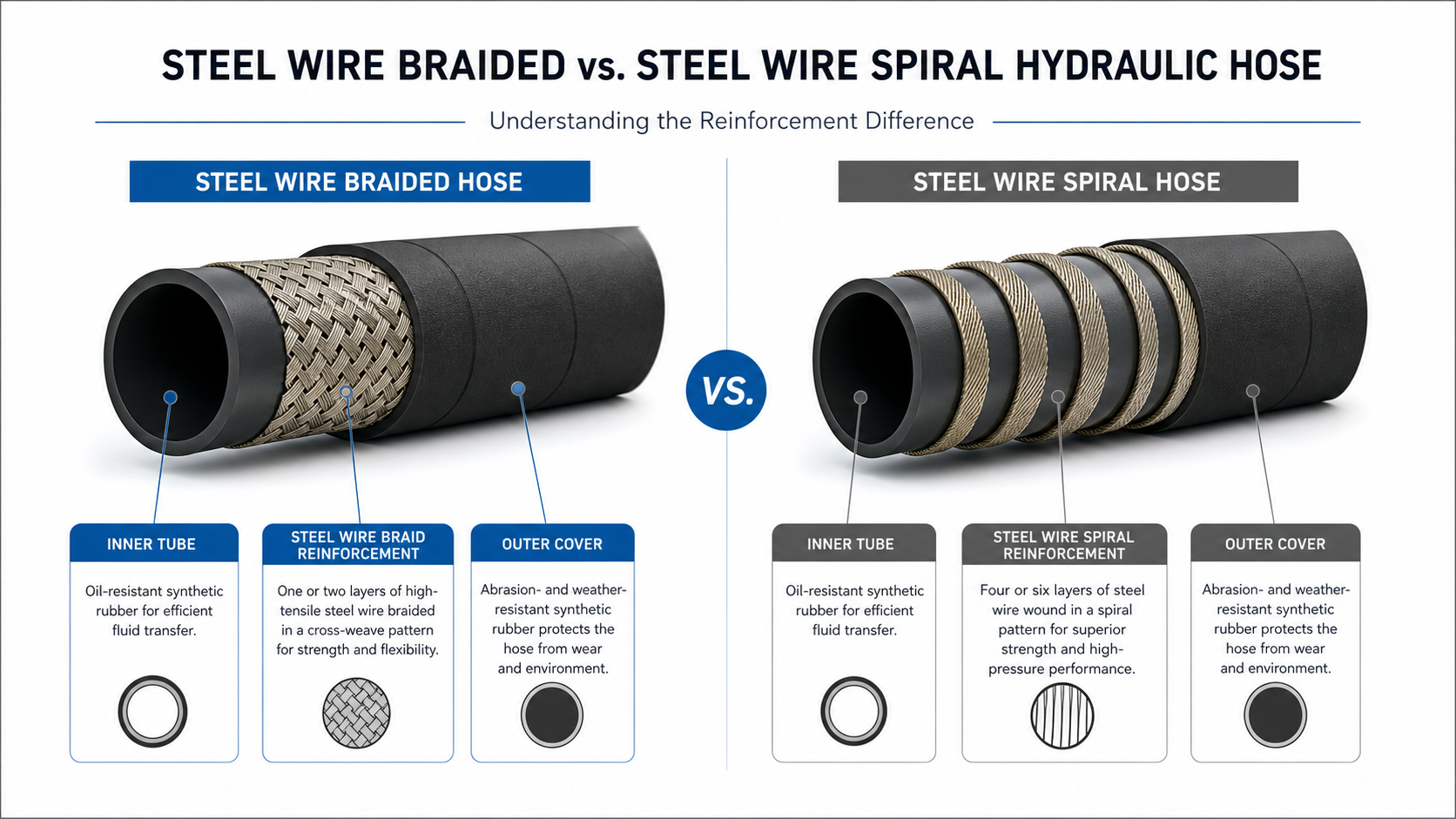
A steel wire braided hydraulic hose uses one or two layers of high-tensile steel wire woven around the inner tube. Common examples include:
- SAE 100R1 / EN 853 1SN: one steel wire braid
- SAE 100R2 / EN 853 2SN: two steel wire braids
- SAE 100R16: compact two-wire braided hose
Braided hoses are widely used in medium- and high-pressure hydraulic systems where flexibility, easier routing, and compact installation are important.
What Is a Steel Wire Spiral Hydraulic Hose?
A steel wire spiral hydraulic hose uses four or six layers of high-tensile steel wire wound in alternating directions. Common examples include:
- SAE 100R12: four-spiral hydraulic hose
- SAE 100R13: heavy-duty spiral hydraulic hose
- SAE 100R15: very high-pressure spiral hydraulic hose
Spiral hoses are designed for severe hydraulic applications with high pressure, pressure surges, and demanding impulse cycles.
Braided vs. Spiral Hydraulic Hose: Key Differences
| Item | Steel Wire Braided Hose | Steel Wire Spiral Hose |
|---|---|---|
| Reinforcement | 1 or 2 crossed steel wire braid layers | 4 or 6 spiral steel wire layers |
| Common Standards | SAE 100R1, SAE 100R2, SAE 100R16, EN 853 1SN/2SN | SAE 100R12, SAE 100R13, SAE 100R15 |
| Pressure Range | Medium to high pressure | High to very high pressure |
| Flexibility | Better flexibility | Stiffer construction |
| Bend Radius | Usually smaller/easier to route | Usually larger and needs more installation space |
| Impulse Resistance | Good for standard hydraulic circuits | Better for severe pressure surges and high impulse cycles |
| Weight | Usually lighter | Usually heavier |
| Cost | Usually more economical | Usually higher cost |
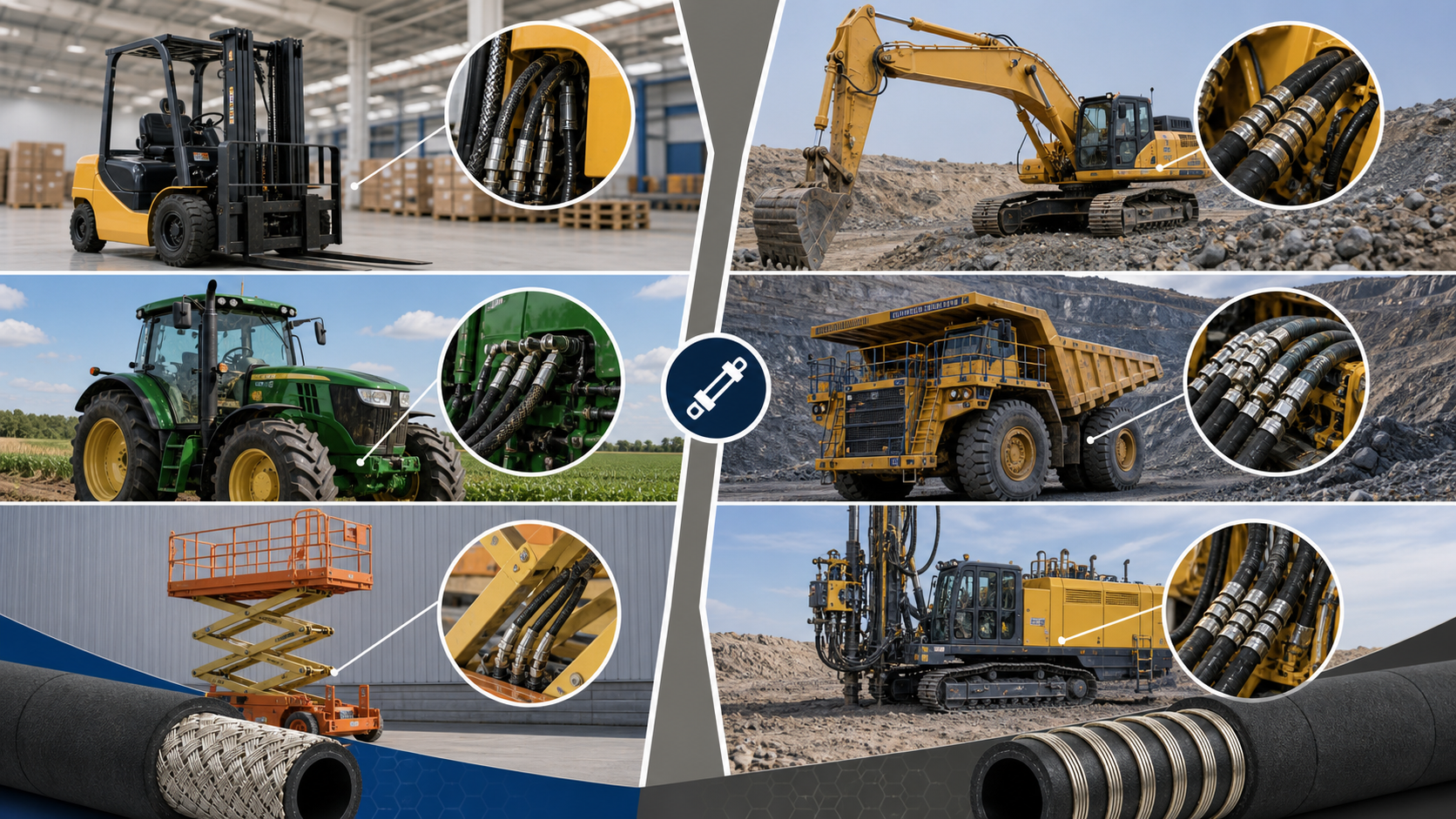
| Typical Use | Forklifts, agriculture, trucks, small excavators, hydraulic lifts | Mining, large excavators, drilling rigs, heavy construction, hydrostatic drives |
Technical Parameter Comparison
The exact data depends on hose size, brand, compound, and standard. The following table is a practical selection reference for buyers and engineers.
| Hose Type | Reinforcement | Typical Working Pressure Level | Typical Temperature Range | Best For |
|---|---|---|---|---|
| SAE 100R1 / EN 853 1SN | 1 wire braid | Medium pressure | Around -40°C to +100°C, depending on compound | General hydraulic lines, return lines, medium-duty equipment |
| SAE 100R2 / EN 853 2SN | 2 wire braids | High pressure | Around -40°C to +100°C, depending on compound | Excavators, loaders, hydraulic presses, mobile machinery |
| SAE 100R16 | 2 wire braids, compact | High pressure with compact routing | Around -40°C to +100°C, depending on compound | Tight installation spaces and OEM equipment |
| SAE 100R12 | 4 spiral wires | High pressure, high impulse | Around -40°C to +121°C, depending on compound | Heavy construction equipment and high-pressure systems |
| SAE 100R13 | 4 or 6 spiral wires | Very high pressure | Around -40°C to +121°C, depending on compound | Mining, large excavators, severe-duty hydraulic lines |
| SAE 100R15 | 4 or 6 spiral wires | Very high pressure, often constant pressure series | Around -40°C to +121°C, depending on compound | Extreme pressure, severe impulse, heavy mobile equipment |
Important note: Always confirm the final working pressure, burst pressure, bend radius, fluid compatibility, temperature range, and coupling compatibility from the hose manufacturer datasheet before ordering.
When Should You Choose Steel Wire Braided Hose?
Choose steel wire braided hydraulic hose when the application needs:
- Flexible routing in limited space
- Medium to high working pressure
- Smaller bend radius
- Easier assembly and installation
- Lower total hose cost
- General hydraulic oil lines without extreme pressure surges
Typical applications include agricultural machinery, forklifts, truck hydraulics, compact excavators, hydraulic lifts, machine tools, and industrial hydraulic power units.
For many common hydraulic systems, SAE 100R2 / EN 853 2SN is a practical and cost-effective choice because it offers two-wire reinforcement with good flexibility and reliable pressure performance.
When Should You Choose Steel Wire Spiral Hose?
Choose steel wire spiral hydraulic hose when the system has:
- Very high working pressure
- Frequent pressure spikes
- Strong vibration
- Severe impulse cycles
- Heavy-duty mobile equipment
- Long service-life requirements under harsh working conditions
Spiral hoses are commonly used on mining machinery, large excavators, drilling rigs, heavy loaders, forestry equipment, hydrostatic drives, and other demanding hydraulic systems.
If a hose fails repeatedly near the fitting or in a high-shock pressure line, upgrading from a two-wire braided hose to a four-spiral or six-spiral hose may improve service life, provided the routing and fittings are also correct.
Selection Checklist: How to Choose the Right Hydraulic Hose
Before selecting a braided or spiral hydraulic hose, check these seven factors:
1. Working Pressure
The hose working pressure must be equal to or higher than the maximum system pressure. For systems with pressure spikes, choose a hose with stronger impulse performance, not only a higher static pressure rating.
2. Impulse and Pressure Surge
Impulse resistance is critical for mobile machinery and heavy equipment. Spiral hoses generally perform better in high impulse applications because the reinforcement is designed for severe pressure cycling.
3. Bend Radius
Installing a hose below its minimum bend radius can shorten service life and cause early failure. Braided hoses are usually easier to route in compact spaces, while spiral hoses need more room.
4. Hose Size and Flow Rate
Undersized hose increases pressure drop, heat generation, and energy loss. Oversized hose may increase cost and reduce routing flexibility. Select the inner diameter based on flow rate and acceptable pressure drop.
5. Hydraulic Fluid Compatibility
Check compatibility with mineral hydraulic oil, biodegradable hydraulic fluid, water-glycol, or other media. The inner tube material must match the fluid.
6. Temperature
High oil temperature and high ambient temperature can reduce hose life. Confirm both continuous and intermittent temperature ratings.
7. Coupling and Crimping System
Hydraulic hose performance depends on the complete hose assembly. Hose, fittings, ferrules, and crimping specifications must match. Do not mix unverified hose and fitting systems in critical applications.
Common Mistakes to Avoid
- Choosing hose only by price
- Replacing a spiral hose with a braided hose without checking impulse requirements
- Ignoring minimum bend radius
- Using the wrong fitting or ferrule
- Installing hose with twist
- Allowing abrasion against steel edges
- Ignoring temperature and fluid compatibility
- Using old hose stock without checking storage condition
Quick Recommendation
For standard hydraulic lines where flexibility and cost are important, choose steel wire braided hose such as SAE 100R1, SAE 100R2, or SAE 100R16.
For severe-duty hydraulic systems with high pressure, pressure spikes, and heavy vibration, choose steel wire spiral hose such as SAE 100R12, SAE 100R13, or SAE 100R15.
Need Help Selecting Hydraulic Hose?
If you are not sure whether your equipment needs a braided hose or a spiral hose, send us your hose size, working pressure, application, hydraulic fluid, temperature, and fitting type. Our technical team can help recommend the suitable hydraulic hose specification for your market.
Recommended inquiry information:
- Hose standard or old hose marking
- Inner diameter
- Working pressure
- Machine type
- Hydraulic fluid
- Temperature condition
- Fitting type and thread
- Quantity and delivery requirement
FAQ
Is spiral hydraulic hose always better than braided hose?
No. Spiral hose is stronger for severe high-pressure and high-impulse applications, but braided hose is often better for flexible routing, standard pressure systems, and cost-sensitive applications.
Can I replace a spiral hose with a braided hose?
Only if the braided hose meets the required working pressure, impulse performance, bend radius, temperature, fluid compatibility, and fitting requirements. In severe applications, replacing spiral hose with braided hose can lead to early failure.
Which hose is more flexible?
Steel wire braided hose is usually more flexible and easier to install in tight spaces. Steel wire spiral hose is generally stiffer because it has multiple spiral reinforcement layers.
Which hose is better for excavators?
Small and medium excavators often use both braided and spiral hoses depending on the circuit. Large excavators, mining machines, and high-pressure boom or arm lines commonly require spiral hoses for better impulse resistance.
What is the main difference between SAE 100R2 and SAE 100R12?
SAE 100R2 is generally a two-wire braided hydraulic hose for high-pressure applications. SAE 100R12 is generally a four-spiral hydraulic hose for high-pressure and high-impulse applications.

